Bird Spikes Company
Company
Shop By Category
T&Cs
Shop Online
  • Free delivery across New Zealand on orders over $75
  • Spikes, netting, gel and deterrents in one place
  • Dispatch within 2 working days, then delivery in up to 7 working days by tracked courier
  • Tracking number emailed as soon as your order ships

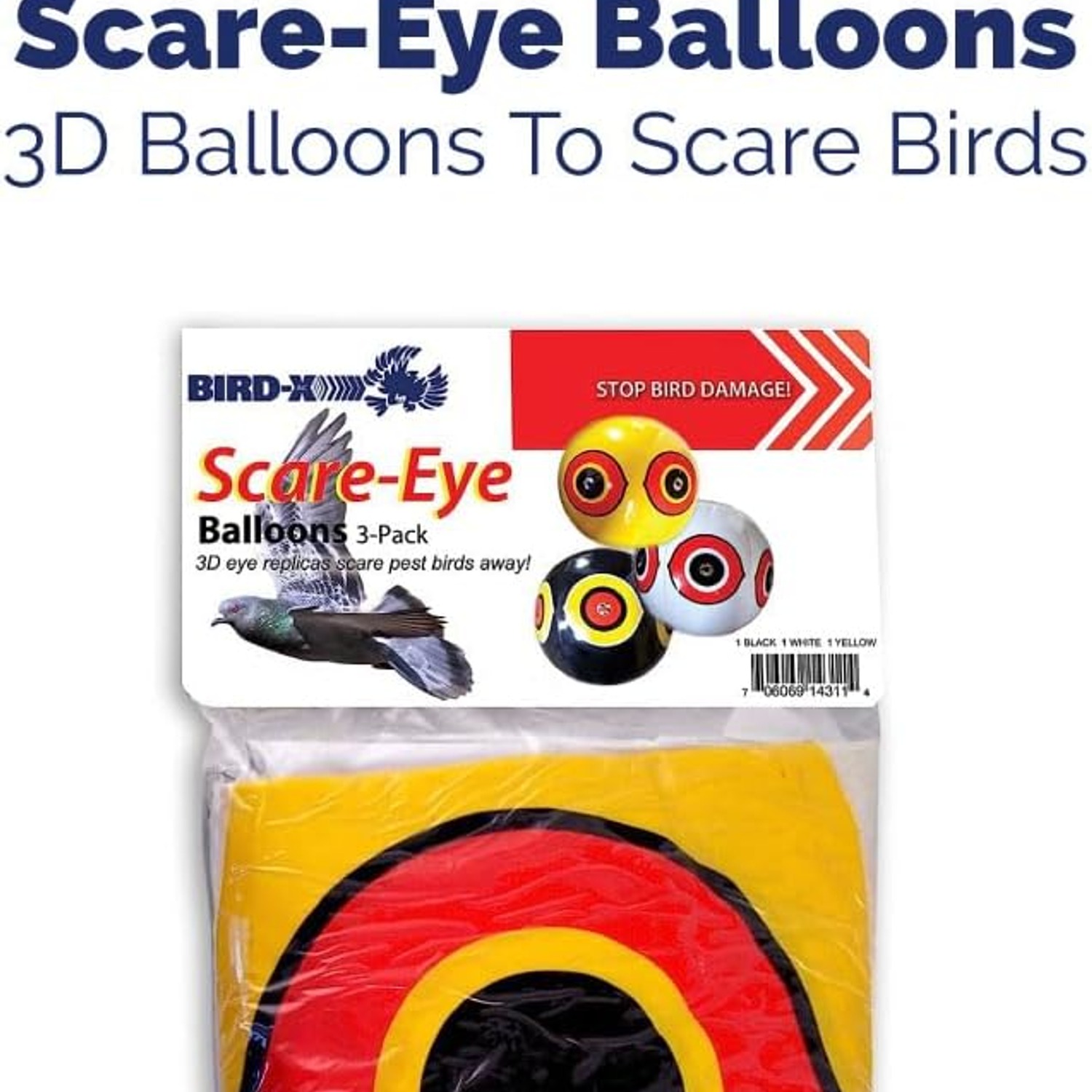
Scare Eye Balloons 3-Pack

Keep pigeons, starlings and seagulls off your property with bird scare balloons that work the moment the wind picks up.

Wind Powered · Predator Eye Print · Humane Control · Three Balloons

$107.99 $129.99 Save $22
  • Wind Powered
  • Predator Eye Print
  • Humane Control
  • Three Balloons

Price: $107.99 $129.99

  • Delivery time: up to 7 working days by tracked courier, after dispatch within 2 working days
  • Free delivery across New Zealand on orders $75+, otherwise Express Delivery at $25
  • Pay by card or PayPal, handled by the payment provider
  • 14 days to change your mind, plus your Consumer Guarantees Act rights
Product specifications
Item TypeVisual decoy
Pack Size3 balloons
ColoursYellow, black and white
Power SourceWind powered
Item Weight0.4 kg
ConditionNew
Weight0.4 kg
Shipping & returns

Tracked delivery anywhere in New Zealand. Free on orders of $75 or more; below that the only method offered is Express Delivery at $25, which is also available above the threshold as a paid upgrade. Allow up to 7 working days in transit after dispatch within 2 working days.

We give you 14 days from delivery to change your mind on an unused item. That is our own policy, not a New Zealand statutory right, because there is no statutory cooling-off period for an online purchase here. Send it back unused and in resaleable condition and we refund what you paid for it. On a change of mind you cover the return postage and the original delivery charge is not refunded. If the item is faulty.

If it arrives faulty, damaged or not as described, we put it right at no cost to you under the Consumer Guarantees Act 1993, return postage included. That is a statutory right and nothing on this page limits it.

Shipping details · Refunds and returns

Wind PoweredMoves and spins on its own with no batteries, wires or refills.
Predator Eye PrintLarge eye markings read as a watching predator to nervous birds.
Humane ControlScares birds off without traps, poisons or sprays.
Three BalloonsCover several problem spots or rotate positions to keep birds guessing.

Keep pigeons, starlings and seagulls off your property with bird scare balloons that work the moment the wind picks up.

A three-pack of 38 cm weatherproof vinyl balloons printed with large predator eyes, wind-powered, chemical-free and simple to inflate and hang wherever birds are causing trouble.

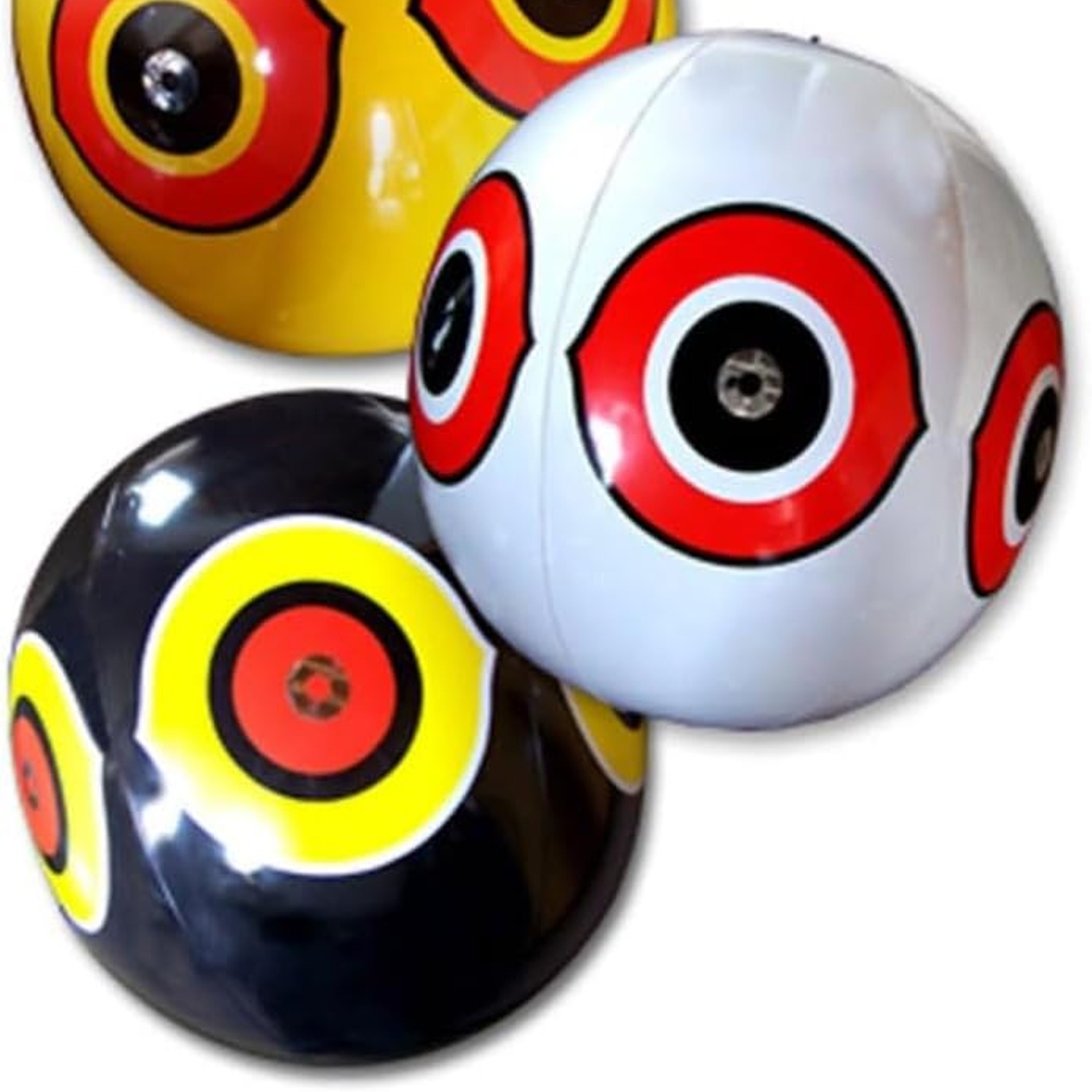
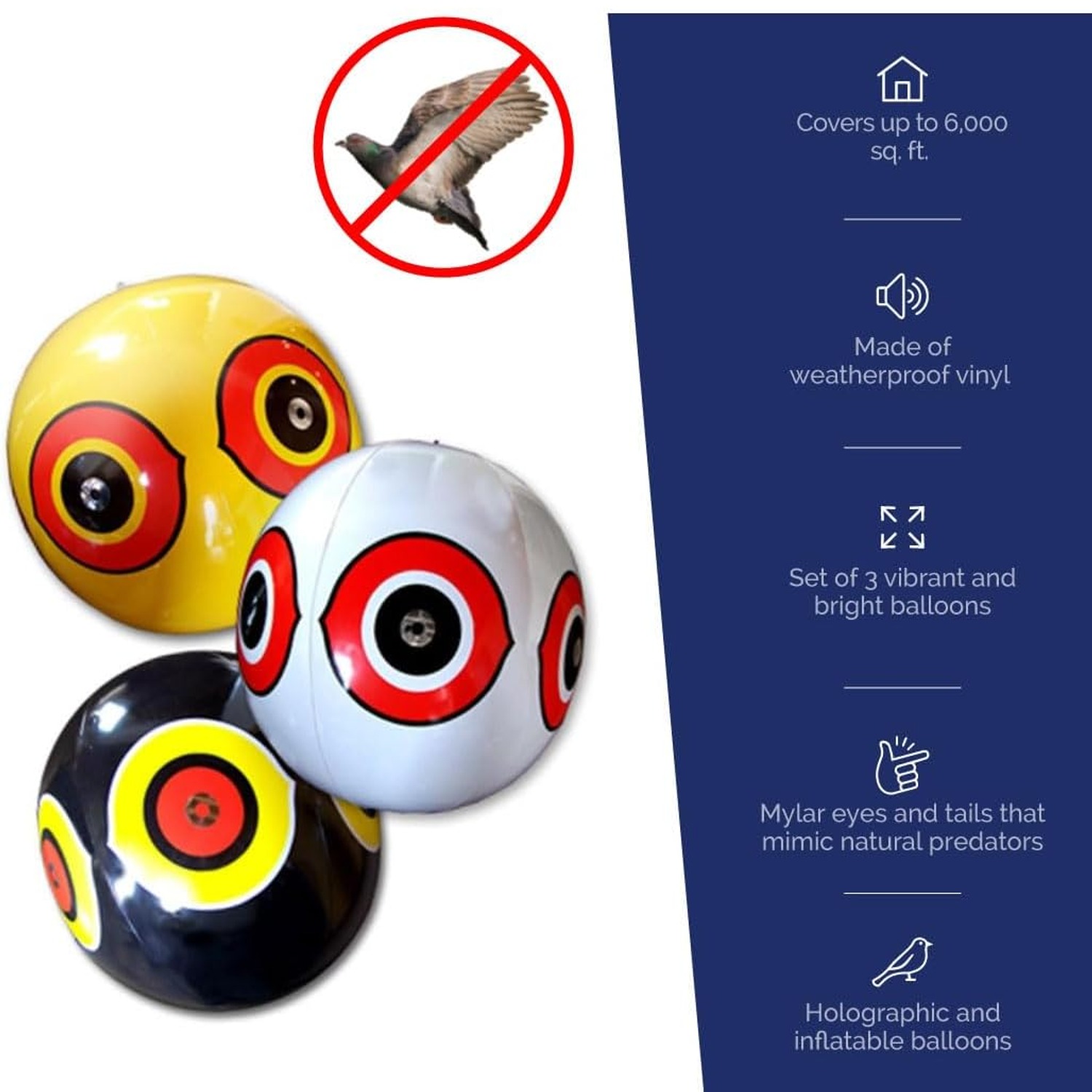
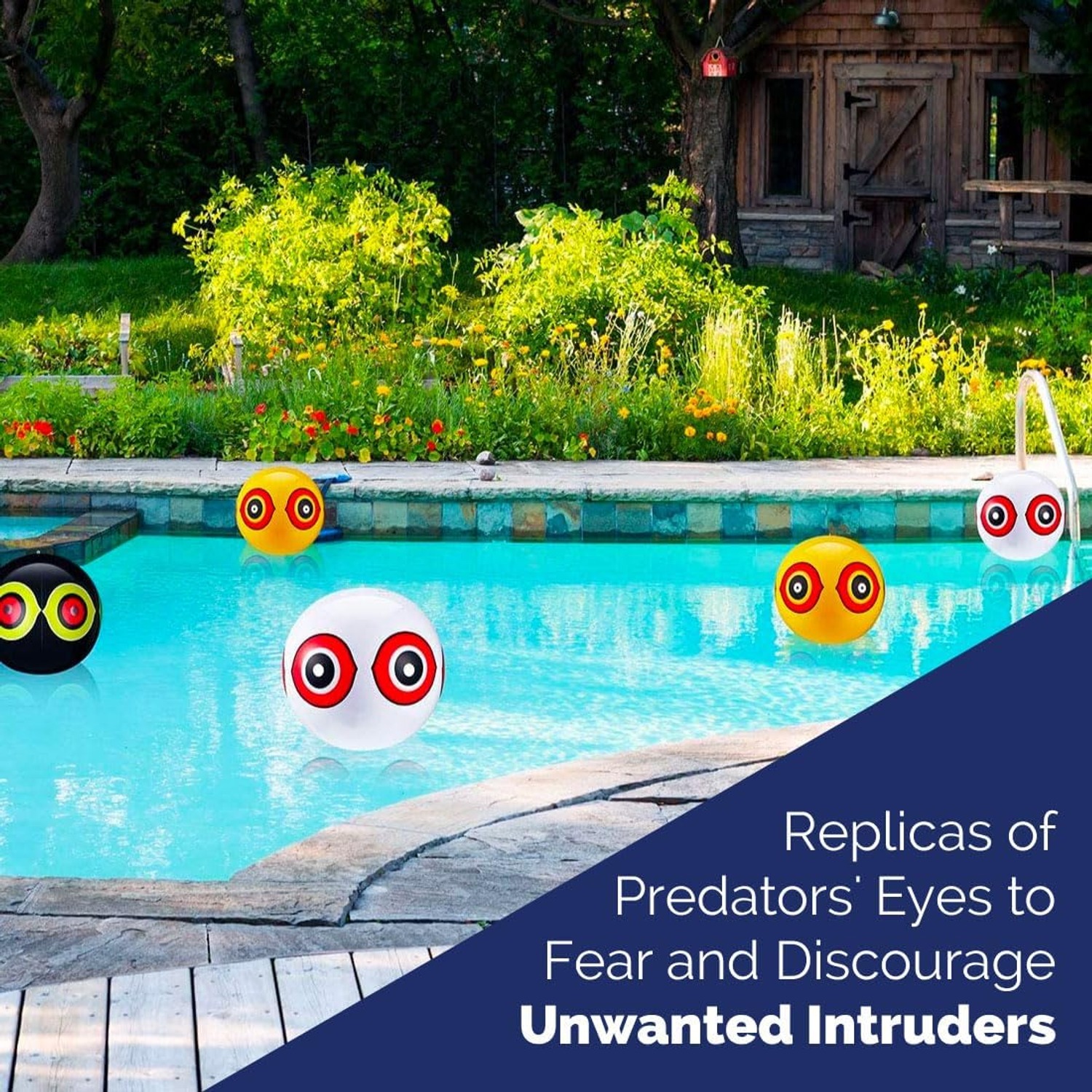
Three inflatable scare eye balloons printed with oversized predator eyes that birds instinctively read as a threat.

Each balloon inflates to about 38 cm and is made from weatherproof vinyl, so it can stay outside through sun and rain.

Wind does all the work, turning and bobbing the balloons so the eyes appear to track any bird that comes close.

Supplied in yellow, black and white for contrast against sky, foliage, roofing and shade cloth.

No power, chemicals or ongoing refills are involved, which makes it an easy option around food gardens, patios and animals.

Scare Eye Balloons 3-Pack

Birds are creatures of habit. Once a flock decides your roofline, fruit trees or loading dock is a safe place to sit, they come back daily, and the mess, noise and damage follow. Scare eye balloons break that habit by putting something in the airspace that looks alive. Each balloon carries huge printed eyes and sharp markings that mimic the face of a predator, and because the balloon turns in the breeze, those eyes seem to swing around and follow any bird that flies near. To a pigeon or starling scanning for danger, that is enough to pick a different perch.

Scare Eye Balloons 3-Pack

This pack contains three balloons, each inflating to roughly 38 cm across, in yellow, black and white. The colour spread is deliberate. A white balloon stands out against dark foliage or a shaded verandah, while black and yellow read strongly against bright sky and pale roofing. Having three also lets you treat more than one trouble spot at a time, or move them around so birds never settle into treating one fixed shape as background furniture.

Scare Eye Balloons 3-Pack

The vinyl is made for outdoor use, so rain, dew and sun are not a problem. There is nothing to plug in, nothing to recharge and nothing to spray. You inflate the balloon by mouth or with a small pump, tie a cord through the tab, and hang it somewhere with clear air around it so the wind can spin it freely. Most people get them up in under ten minutes for the whole set, and the only ongoing job is a top-up of air now and then and the occasional wipe-down.

Scare Eye Balloons 3-Pack

Because this is a visual deterrent rather than a trap or a chemical, it sits comfortably in places where other methods feel wrong. Vegetable patches, chicken runs, berry nets, kids' play areas, cafes with outdoor seating, boats and marina berths all suit a balloon far better than anything involving bait or spikes. Nothing is harmed. Birds simply decide the spot is risky and move along to somewhere that feels safer, which is exactly the outcome most people are after.

Scare Eye Balloons 3-Pack

Expect best results when you treat the balloons as one part of a plan rather than a set-and-forget fix. Birds adapt to anything static, so shifting a balloon to a new hook every week or two, and pairing it with simple housekeeping like clearing spilt feed or sealing a nesting gap, keeps the pressure on. Used that way, a handful of balloons can quietly protect a surprisingly large area for a long time.

Not sure yet? That is fine.

You can change your mind. We give you 14 days from delivery on any unused item. That is our own policy rather than a New Zealand statutory right, because there is no statutory cooling-off period for an online purchase here, and we would rather say so than imply a right you do not have. Send it back unused and in resaleable condition and we refund what you paid for it; on a change of mind you cover the return postage.

If it turns up faulty, damaged or not as described, that is on us. The Consumer Guarantees Act 1993 gives you a repair, a replacement or your money back, we pay the return postage, and nothing on this page limits that. Read the detail on our refunds and returns page, or ask us anything before you order.

Frequently Asked Questions

What exactly is in the pack?

You get three inflatable scare eye balloons, one yellow, one black and one white. Each is printed with oversized predator eye markings. The pack has a listed weight of 0.4 kg.

How do bird scare balloons actually work?

Birds watch constantly for predators, and a large pair of eyes is one of the strongest danger signals they have. The balloon turns in the wind, so the eyes appear to move and follow any bird that comes near. Most birds respond by avoiding the area rather than testing it.

How big is each balloon?

Each balloon measures about 38 cm across when fully inflated. That is large enough to be visible from a distance in open air.

Do they need batteries or power?

No. They are wind powered, which is the whole point of the design. There is nothing to charge, plug in or replace.

Which birds do they target?

They are aimed at common nuisance species such as pigeons, sparrows, starlings, swallows, woodpeckers, crows, blackbirds, ducks and gulls. Results vary by species and how committed the birds are to the site. Birds that are already nesting are usually harder to shift than birds that are just loafing.

Are they safe around pets and children?

Yes, there is nothing toxic, sharp or electrified involved. Hang them out of easy reach so curious hands and paws do not pull them down. Keep loose cord tidy for the same reason.

Will they harm the birds?

No. This is a visual deterrent, so birds simply choose to go elsewhere. Nothing traps, stuns or injures them, which is why it is one of the best humane bird repellent options for home use.

How much area does one balloon cover?

Coverage depends on sightlines, wind and how bold the birds are. In open, uncluttered space a single balloon influences a wide area, while a cluttered yard with lots of visual cover needs more units placed closer together. Using all three usually gives better results than relying on one.

Where should I hang them?

Pick a high, open spot where the wind can turn the balloon freely and birds can see it on approach. Eaves, pergola beams, fence posts, mast lines, tree branches and warehouse rafters all work. Avoid tucking them against a wall where they cannot move.

How do I inflate them?

Inflate by mouth or with a small hand pump until the balloon is firm but not drum tight. Leaving a little give helps the vinyl cope with heat expansion. Check the air level every few weeks.

How do I hang them?

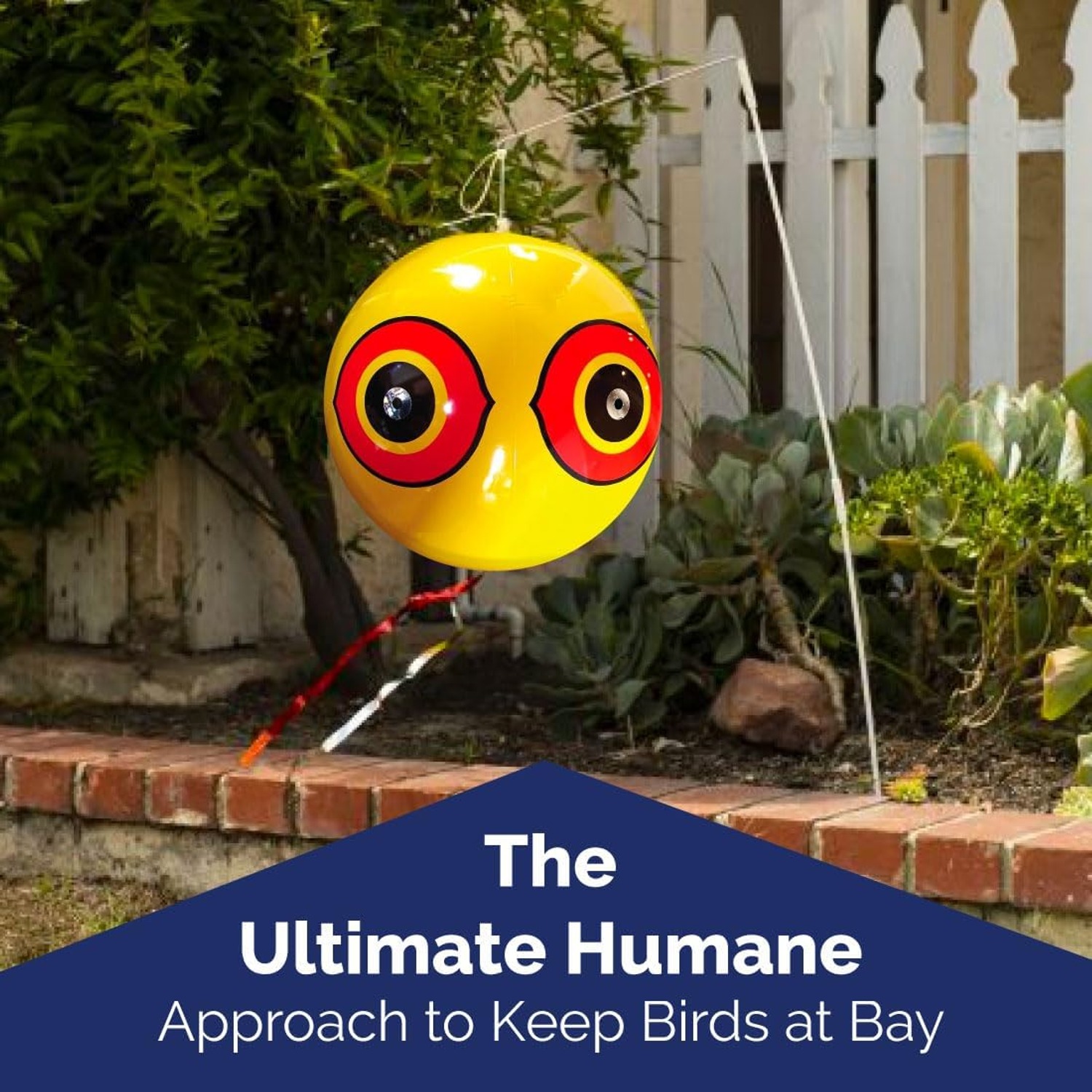
Thread cord or light rope through the hanging tab and tie it off to a hook, branch or beam. Leave enough slack that the balloon can swing and spin rather than sitting rigid. Monofilament line also works well and is nearly invisible.

Can I use them indoors?

You can hang them inside a barn, shed or warehouse where birds get in through open doors. Without wind they move less, so place them near doorways or vents where air flows. Giving them a nudge when you walk past also helps.

Do birds get used to them?

They can, especially if the balloon stays in exactly the same place for months. Moving each balloon every week or two keeps the effect fresh. Rotating between colours and heights helps too.

Are they good for fruit trees?

Yes, this is one of the best balloon bird scarer for fruit trees applications because the balloons hang easily from branches and move with any breeze. Put them up before the fruit colours rather than after birds have found it. Combine with netting on your most valuable trees.

Will they work on a rooftop or solar panels?

They can help on open rooftops where wind is plentiful and birds are perching rather than nesting underneath. Anchor the cord firmly, since rooftop gusts are strong. For birds already nesting under panels, you will also need to block the gap.

Can I use them on a boat?

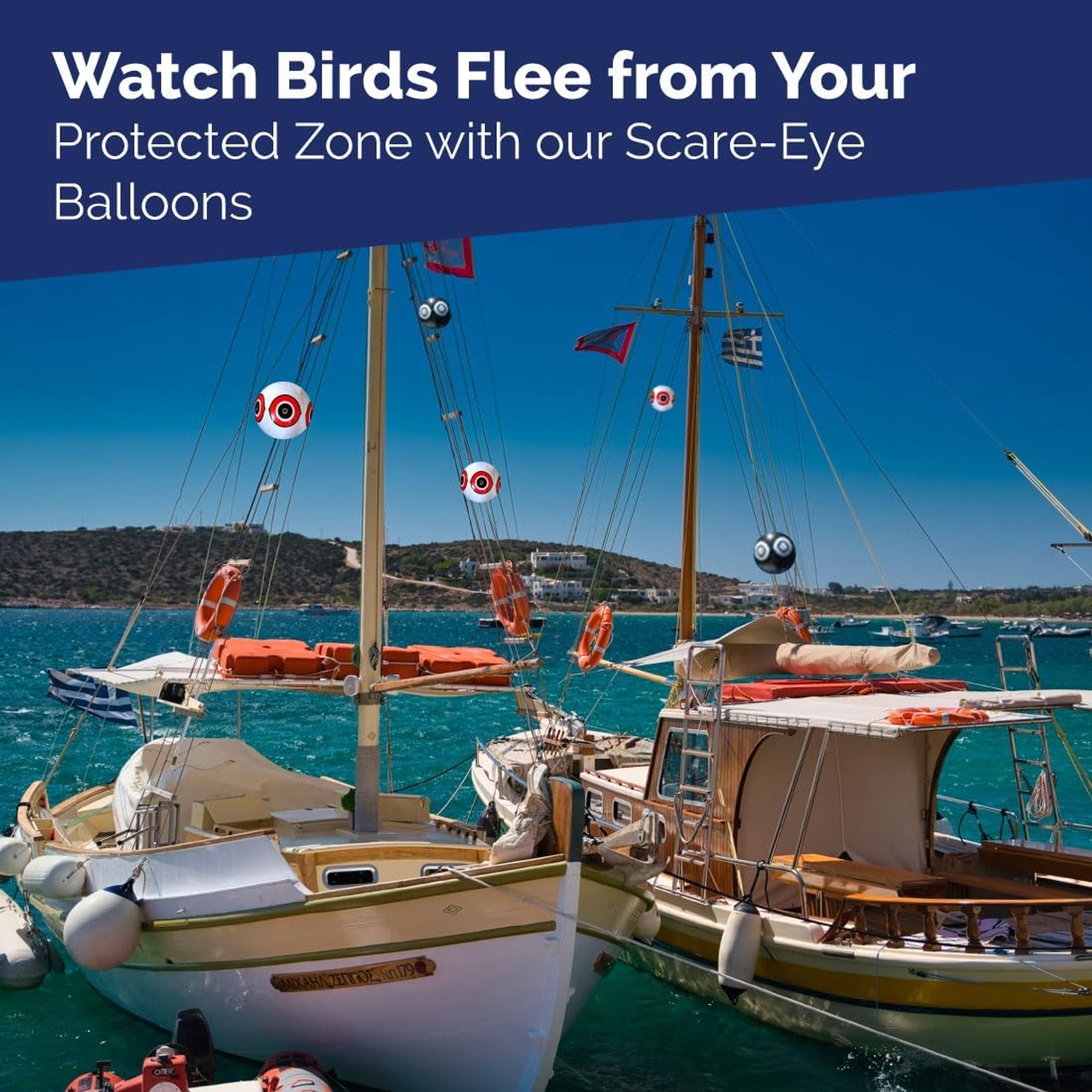
Yes, many people hang them from masts, booms or bimini frames to keep gulls off. Use secure knots and check them after rough weather. The reflective, high contrast colours stand out well over water.

What about vegetable gardens?

They suit vegetable patches well because there is no spray or bait near food crops. Hang them on stakes or an overhead wire above the beds. Many gardeners rate them among the best bird scarer for vegetable gardens for exactly that reason.

Do they work at night?

Not really. The deterrent relies on birds seeing the eyes, so it works during daylight. Most problem birds are active in daylight anyway, so this is rarely an issue.

How long do they last outdoors?

The vinyl is weatherproof and built for outdoor use, so the balloon itself tends to outlast the cord holding it. Harsh sun will fade printing over time. Checking the hanging line every month or so is the single best maintenance habit.

Can I deflate and store them?

Yes. Let the air out, roll them loosely and store them somewhere dry and out of direct sun. Avoid sharp creases and do not store them under heavy objects.

How do I clean them?

Wipe with a damp cloth and mild soapy water, then rinse and dry before rehanging. Skip solvents and scouring pads, which can damage the printing. A quick clean each season keeps the eyes bright and visible.

What if the balloon loses air?

Top it up, the same way you inflated it. Air loss is normal with temperature swings, especially overnight. If a balloon keeps going soft quickly, check the valve area for a nick.

Can I combine them with other bird control?

Yes, and that usually works better than any single method. Pair the balloons with netting, spikes on narrow ledges, or simply removing food sources. Varying the type of deterrent is what stops birds settling in again.

Are these suitable for commercial sites?

They are commonly used around loading docks, warehouses, farm sheds and outdoor dining areas. They are cheap to deploy, need no power and cause no disruption to staff. For large sites, treat each problem zone separately rather than hoping one balloon covers everything.

What colours do I get and does it matter?

The set includes yellow, black and white. Different backgrounds suit different colours, so white shows up against dark foliage while black and yellow pop against bright sky. Having the mix lets you pick what stands out at your site.

Is any assembly needed?

Only inflating and tying on a cord. There are no tools, fixings or instructions to wrestle with. Most people have all three balloons up in about ten minutes.

Do they make noise?

No. They are a silent visual deterrent, which makes them suitable for residential areas, patios and places where a noise device would annoy neighbours.

How soon will I see results?

Many people notice a change in bird behaviour within the first day or two. Birds with a long established roost may take longer and need the balloons repositioned a few times. Persistence matters more than quantity.

What is the warranty?

Your purchase is covered by the Consumer Guarantees Act 1993. If it is faulty, not fit for purpose or not as described, email theteam@birdspikes.co.nz with your order number and a photo, and we will arrange a repair, replacement or refund.

What if it is not right for my situation?

You have 14 days from delivery to change your mind on an unused item in resaleable condition, and you cover the return postage. If it arrives faulty or not as described, the Consumer Guarantees Act 1993 covers you and we pay the return postage. Email theteam@birdspikes.co.nz with your order number.

Bird Scare Balloons Buyer's Guide - Choosing, Placing and Getting Results

6 min read Bird Spikes Company

The problem with birds that have made themselves at home

Birds are not a problem until they decide your property is convenient. Then it happens fast. A few pigeons find the warm ledge above your patio, starlings work out the fruit tree is unguarded, gulls learn the loading dock gets food scraps at the same time every afternoon. Within a couple of weeks you have droppings on the furniture, stained paintwork, nesting material in a vent and a daily cleanup job you never asked for. The frustrating part is that the damage keeps coming back. You can pressure wash a deck or repaint a railing, but if nothing changes about how safe the birds feel, they return the next morning. Droppings are acidic and will mark render, paint and vehicle finishes. Nests in vents and flues are a genuine fire risk. In food businesses, birds near outdoor seating are a health complaint waiting to happen. Most people start with the harshest option they can find. That is usually a mistake. Poisons and traps bring legal issues, ethical issues and a mess to deal with. Spikes and netting work brilliantly in the right spots but are expensive, slow to install and useless over open ground. There is a gap in between for something cheap, humane and quick, and that is where visual deterrents like scare eye balloons sit. ## How a predator eye balloon actually changes bird behaviour

Birds survive by being nervous. A pigeon spends most of its day scanning for anything that might be a hawk, a cat or a person with intent. Two large round eyes staring back is one of the oldest danger signals in nature, and plenty of moths and butterflies evolved fake eyespots for exactly that reason. A predator eye balloon borrows the same trick. Each balloon is printed with huge eye markings and sharp face detail at a scale a bird reads from a distance. On its own, a static picture of an eye loses power quickly. What makes the balloon work is movement. Because it hangs on a cord and catches every breeze, it turns, bobs and swings. The eyes never sit still, and from a bird's point of view they seem to swivel and follow as it flies past. The site stops feeling safe. The effect is strongest on birds that are passing through or casually perching. A flock scouting for a new roost will usually pick the quieter property down the street instead. Birds already deep into nesting are harder to shift, because the pull of the nest site outweighs a moderate scare. That is worth knowing before you buy, since the best time to put these up is before the problem is fully established. Wind power is the other part of the equation. There is no motor, no solar panel and no battery that dies in winter. The same breeze that annoys you is what keeps the deterrent running, which makes this one of the best wind powered bird scarer formats for exposed sites like rooftops, docks and open paddocks. ## Who these suit

This three-pack covers a lot of ground. Home gardeners use them over berry canes, vegetable beds and stone fruit, where spraying anything near food feels wrong. Boat owners hang them from masts and bimini frames, since gulls on a deck are a daily cleaning job. Cafe and restaurant owners put them near outdoor seating where birds have learned that tables mean crumbs. On the commercial side, they turn up around warehouse doors, loading bays, farm sheds, silos and machinery yards. The appeal there is simple. They cost very little per square metre of protected area, they need no electrical work, and nobody has to climb a ladder to service them. For anyone comparing options for the best bird control for loading docks, that combination of low cost and zero maintenance is hard to match. They are a weaker fit in two situations. The first is dead still air, like a fully enclosed courtyard with no breeze at all, where the balloon barely moves. The second is dense cover, such as a thick hedge or a cluttered pergola where birds can sit with the balloon out of sight. In both cases, placement matters more than the product. ## How to choose and where to put them

The decision is less about which balloon and more about how many and where. Think in terms of problem zones rather than total property size. A single balloon influences the open airspace it can be seen from, so one hanging on the patio does nothing for the fruit trees at the back fence. With three in the pack you can treat two or three separate zones, or concentrate all three on one bad spot. Height helps. Hang the balloon above the level birds normally perch at, so they look up at it on approach. Keep clear air around it in at least two directions so it can spin instead of knocking against a wall. Tie it with enough slack that the cord does not act like a splint, and use a line that can handle UV, since the cord almost always fails before the vinyl does. Colour choice is worth a minute of thought. The set includes yellow, black and white for a reason. A white balloon disappears against a bright overcast sky but stands out sharply against a dark hedge. Black and yellow do the opposite. Walk out to where the birds come from, look back at your intended hanging spot, and pick the balloon that your eye catches first. If you cannot spot it easily, neither will a bird at speed. The last and most important rule is to move them. Birds habituate to anything predictable. Shifting each balloon to a different hook every week or two, swapping colours between positions and occasionally changing the hanging height resets the effect. People who report poor results almost always hung one balloon in one place and left it there for six months. ## Care and keeping them working

Maintenance is light. Check the air level every few weeks, since temperature swings will soften a balloon overnight. Inflate until it is firm but with a little give, because a rock hard balloon has nowhere to expand on a hot afternoon. Wipe them with a damp cloth and a bit of mild soapy water when dust or droppings dull the printing, then rinse and let them dry before rehanging. The eyes only work if they are visible, so a quick clean each season is worth the five minutes. Skip solvents and scrubbing pads. Inspect the cord more often than the balloon. Sun and constant movement wear a line down well before weatherproof vinyl gives up. Re-tie or replace cord at the first sign of fraying, especially on rooftops and masts where a loose balloon can end up in a neighbour's yard. If you only need seasonal protection, say for a few weeks while fruit ripens, deflate the balloons afterwards, roll them loosely and store them somewhere dry and out of direct sun. They pack down to almost nothing. Storing them between seasons also helps, because birds that have not seen the balloons for months react to them more strongly when they reappear. ## Pairing them with other methods

Visual deterrents do their best work as part of a layered approach. Netting is still the surest protection for a prized fruit tree. Spikes are the right answer for a narrow ledge above a doorway. Sealing a gap under a solar panel or capping a chimney solves a nesting problem permanently. What the balloons add is pressure over open space, which none of those fixed solutions handle well. They also give you flexibility. When the birds shift from the shed roof to the fence line, you move a balloon in ten minutes rather than booking a contractor. And removing the reason birds came in the first place, whether that is spilt grain, open bins or a pet food bowl left outside, doubles the effect of everything else you do. ## The short version

Scare eye balloons are a cheap, humane and quick way to make a space feel unsafe to birds. You get three in the pack, each around 38 cm when inflated, in yellow, black and white, printed with large predator eyes. Wind does the work, so there are no batteries, wiring or chemicals to deal with. Hang them high, in open air, where birds will see them on approach. Pick the colour that contrasts most with the background behind it. Move them every week or two so the birds never settle in, and keep an eye on the hanging cord. Do that, and three small balloons will keep a surprising amount of mess, noise and damage off your property for a long time.

Browse the shop

Not sure where to hang them?

Tell us where the birds are landing and we will suggest the best placement for your yard, roof or garden.

Ask us a question

Page summary

Scare Eye Balloons is a three-pack of inflatable visual bird deterrents sold in yellow, black and white. Each balloon is printed with large predator eye markings and inflates to roughly 38 cm, and the set has a listed item weight of 0.4 kg. The balloons are wind powered, so they need no batteries, wiring, chemicals or refills. They are hung on cord in open air where the breeze turns them, making the printed eyes appear to track approaching birds such as pigeons, starlings, sparrows and gulls. Typical uses include gardens, fruit trees, patios, rooftops, loading docks, warehouses and boats.